






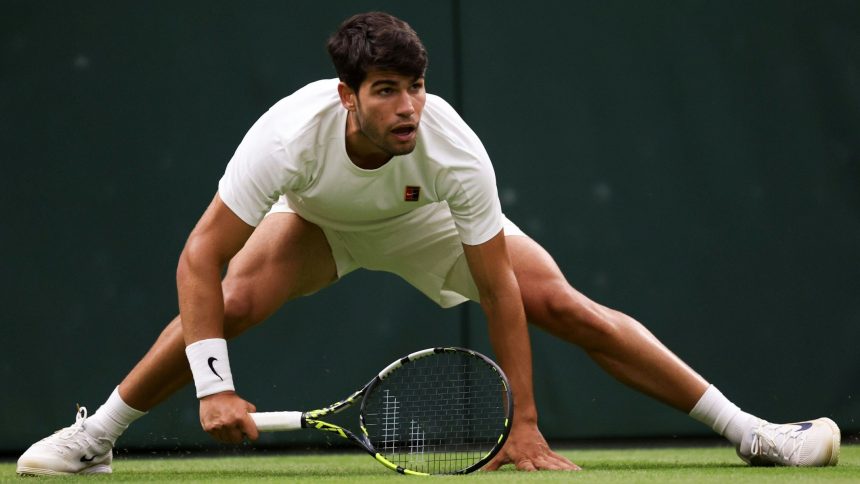
Carlos Alcaraz has delivered a defining moment in men’s tennis by capturing the 2026 Australian Open men’s singles title and becoming the youngest man in the Open Era to complete the Career Grand Slam — winning all four major tournaments before the age of 23. Alcaraz defeated Novak Djokovic in the final at Melbourne Park, 2–6, 6–2, 6–3, 7–5, to secure his first title at the Australian Open and his seventh Grand Slam overall.
A Historic Victory in Melbourne
In the championship match at Rod Laver Arena, Alcaraz rebounded after dropping the opening set to the 38-year-old Djokovic, who had been unbeaten in Australian Open finals. The Spaniard shifted momentum with powerful baseline play and tactical variety, eventually overcoming Djokovic in four sets. With this victory, Alcaraz ended Djokovic’s perfect 10–0 record in Australian Open finals and added the one major title that had eluded him until now.
Alcaraz’s win at the Happy Slam — the first Grand Slam of the calendar year — marks a milestone both personally and in the broader history of tennis. Entering the tournament, he had already secured major titles at Wimbledon, the French Open and the US Open. His success in Melbourne now places him in an elite group of men who have achieved a Career Grand Slam, joining the likes of Rod Laver, Novak Djokovic, Rafael Nadal, Roger Federer and Andre Agassi.
Record-Breaking Achievement
At just 22 years and 272 days old, Alcaraz is the youngest male player ever to complete the Career Grand Slam in singles — surpassing a record that stood for more than eight decades. The previous benchmark was set by American Don Budge in 1938, who captured his four majors at Roland Garros.
This victory also cements Alcaraz’s place among the most accomplished young athletes in tennis history. With seven Grand Slam titles before turning 23, he has become one of the most prolific champions of his generation and already ranks among all-time greats in Open Era statistics.
Generational Shift on the Court
The 2026 Australian Open final was more than just a title match — it was a symbolic moment in the ongoing generational transition in men’s tennis. Djokovic, widely regarded as one of the greatest players of all time, stood as a formidable opponent. His attempt to win a record 25th major and extend his dominance in Melbourne was halted by Alcaraz’s relentless performance.
Djokovic publicly acknowledged the historic nature of Alcaraz’s achievement, calling the Spaniard’s performance “legendary” and recognizing the work that went into reaching this point. His praise underscored the respect top competitors hold for Alcaraz as he continues to shape the sport’s future.
Alcaraz’s Broader Impact
Beyond the immediate statistics, Alcaraz’s triumph in Melbourne signals the rise of a new era in men’s tennis. His comprehensive game — combining power, speed, tactical intelligence and mental resilience — has made him a formidable presence on all surfaces. Since winning his first major at the US Open in 2022, he has consistently challenged and defeated the sport’s elite.
The achievement also fuels speculation about Alcaraz’s potential to pursue even rarer feats, such as a calendar-year Grand Slam. The last man to win all four majors in a single season was Rod Laver in 1969 — a record that has stood for more than half a century. While Alcaraz has not publicly set that goal, his performance through the early 2026 season has invited comparisons and heightened expectations.
Legacy and Looking Forward
As Alcaraz basks in the glow of his historic Australian Open victory, the tennis world is already looking ahead to the rest of the season. With a blend of youth, skill and competitive appetite, he is poised to remain a central figure in the sport’s narrative for years to come. His success in Melbourne not only adds a prestigious title to his resume but also reaffirms his role as a leader of the next generation of champions.
In capturing the Career Grand Slam at such a young age, Carlos Alcaraz has rewritten the record books and etched his name among tennis’s all-time legends.
7 years in the field, from local radio to digital newsrooms. Loves chasing the stories that matter to everyday Aussies – whether it’s climate, cost of living or the next big thing in tech.