



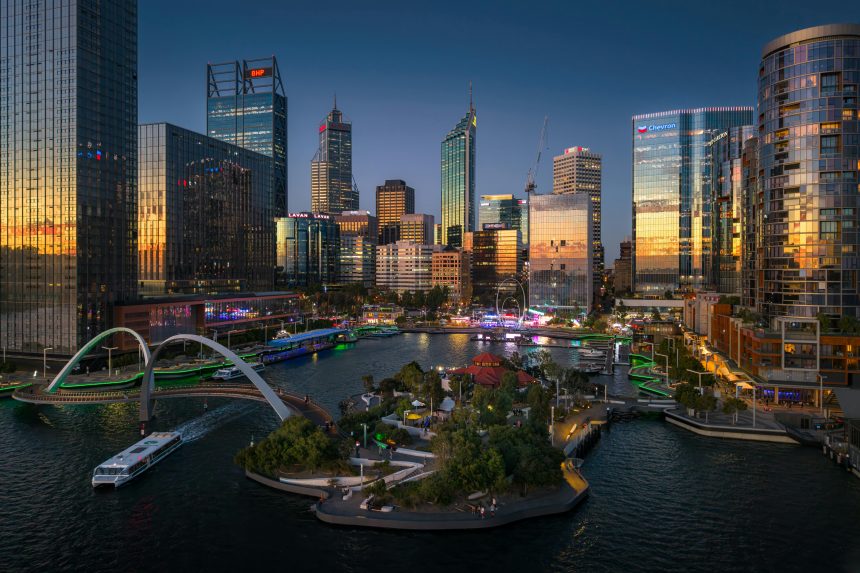
For decades, Perth was framed as Australia’s geographic outlier—a sunlit city closer to Asia than to its own eastern capitals. Distance was often treated as a disadvantage: fewer touring acts, limited media attention, and long flights separating Western Australia from the cultural centers of Australia.
Yet over time, that same isolation has helped Perth develop one of the country’s most distinctive creative ecosystems. Today, the city punches far above its weight in music, visual arts, design, film, fashion, and food culture. Its remoteness has not diluted creativity; it has intensified it.
This article examines how Perth’s isolation became a catalyst—rather than a constraint—for cultural innovation.
Geography as a Creative Filter
Perth is one of the most isolated major cities in the world. The nearest Australian capital, Adelaide, is more than 2,000 kilometers away by road. For creatives, this physical separation has long shaped how ideas circulate and how scenes form.
Without constant external influence, Perth’s cultural output evolved with a stronger internal logic. Artists, musicians, and designers often had to rely on each other rather than waiting for validation from interstate or international markets. This created a self-reinforcing loop: collaboration became essential, experimentation more acceptable, and originality more valuable.
Isolation acted as a creative filter, slowing trends but deepening them.
A DIY Ethos Born From Distance
Building Instead of Borrowing
Perth’s creative infrastructure grew from necessity. Touring acts arrived less frequently, national media coverage was sporadic, and funding pipelines were thinner. In response, local creatives learned to build what they couldn’t import.
Independent music venues, artist-run galleries, pop-up festivals, and self-published media became foundational rather than supplementary. The result was a culture less dependent on external approval and more focused on sustainable local audiences.
This DIY ethos is still visible today, particularly in:
- Independent record labels and rehearsal spaces
- Artist-run exhibition venues
- Community-driven festivals and events
Rather than imitating eastern states’ scenes, Perth developed parallel ones—similar in ambition, different in tone.
The Role of Time, Space, and Lifestyle
Creativity With Room to Breathe
Perth’s physical environment plays a critical role in shaping its creative output. Compared to Sydney or Melbourne, the city offers:
- More space
- Lower population density
- A slower, less congested pace of life
This combination has allowed creatives to spend more time refining work rather than constantly responding to market pressure. Studios are larger, rents have historically been lower, and commutes shorter. These conditions support long-term creative development rather than rapid turnover.
The city’s natural surroundings—coastline, bushland, and open skies—also feed directly into its visual and sonic identity. Perth’s creativity often feels spacious, unhurried, and deliberate.
Music as the City’s Global Export
Perhaps nowhere is Perth’s creative success more visible than in music. Despite its distance, the city has produced an outsized number of internationally recognized acts across rock, electronic, and experimental genres.
What distinguishes Perth’s music scene is not volume, but consistency of identity. Artists often share:
- A strong sense of place
- Sonic experimentation without trend-chasing
- Long development cycles before wider exposure
Because “breaking out” requires leaving the city—often literally—Perth musicians tend to refine their sound extensively before presenting it to the world. Isolation raises the threshold for release, which in turn raises quality.
Creative Communities Over Creative Industries
Collaboration Over Competition
Perth’s smaller creative population has encouraged cross-disciplinary overlap. Musicians collaborate with visual artists. Designers work with chefs. Filmmakers share spaces with photographers.
Rather than siloed industries, Perth functions as an interconnected creative community. This has produced hybrid practices and blurred boundaries between art forms, contributing to the city’s distinctive output.
Importantly, success in Perth is often defined internally—by peer respect and creative fulfillment—rather than purely by commercial metrics.
The Tension Between Isolation and Visibility
Isolation remains a double-edged sword. While it fosters originality, it can limit exposure. Many Perth creatives eventually relocate east or overseas to scale their work. Yet even when they leave, the city’s influence often remains embedded in their practice.
In recent years, digital platforms have softened Perth’s distance disadvantage. Online distribution, remote collaboration, and global audiences have reduced the need for physical proximity to cultural centers. This has allowed more creatives to remain in Perth while maintaining national or international reach.
The result is a city that exports culture without exporting all of its creators.
A City Comfortable With Its Own Pace
One of Perth’s defining creative traits is its resistance to urgency. Trends arrive later—and often leave earlier. What remains is a culture shaped less by hype cycles and more by longevity.
This has positioned Perth not as a follower or challenger to Australia’s eastern capitals, but as something else entirely: a city confident in its own rhythm.
Final Thoughts: Isolation as Identity
Perth did not become a creative hub in spite of its isolation—it became one because of it. Distance forced self-reliance. Limited access encouraged originality. Space allowed ideas to mature.
In an era where creative cities increasingly compete for speed, scale, and visibility, Perth offers a counter-model: one where isolation sharpens identity, and where creativity grows quietly, deeply, and on its own terms.
7 years in the field, from local radio to digital newsrooms. Loves chasing the stories that matter to everyday Aussies – whether it’s climate, cost of living or the next big thing in tech.