



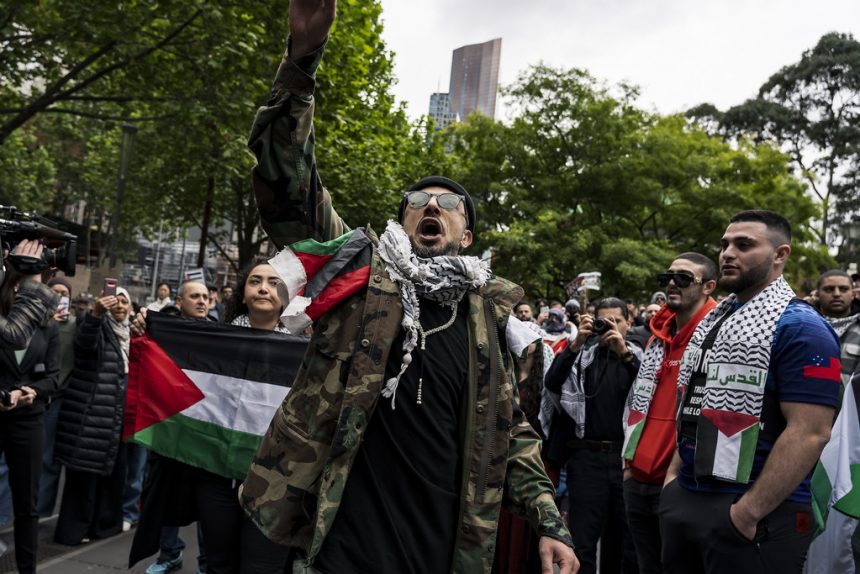
Melbourne — Thousands of people gathered in the heart of Melbourne on the final day of Isaac Herzog’s state visit to Australia, staging a large, often vocal protest outside Flinders Street Station and through the central business district. The demonstrations, among the largest seen during the four-day visit, brought into relief deep divisions in Australian public debate over the war in Gaza, political responses to antisemitic violence and the policing of large-scale political gatherings.
Crowd size, route and atmosphere
Organisers and multiple media outlets estimated the crowd in the thousands, with demonstrators assembling near Flinders Street before marching through city streets carrying banners and Palestinian flags and chanting slogans such as “Free, free Palestine” and “Herzog out.” The protest formed part of a sequence of demonstrations held in Sydney, Canberra and Melbourne during the same period of the president’s visit. The mood ranged from defiant to mournful, with speakers addressing civilian casualties in Gaza and calling for accountability.
Why people turned out
Organisers said the rallies were intended to oppose what they described as state-level endorsement of policies they say have contributed to civilian suffering in Gaza. Many participants framed their presence as an expression of solidarity with Palestinians and a demand for international accountability; some attendees described personal losses or family ties to the conflict. At the same time, Jewish and broader community leaders said the visit was intended to reassure Australia’s Jewish population after a deadly attack in Sydney in recent months, underscoring the fraught mix of grief, security concerns and geopolitical disagreement that surrounded the visit.
Police presence, designated areas and limited clashes
Victoria Police deployed a significant security operation across parts of the CBD, citing intelligence about large gatherings and seeking to protect public safety and lawful movement. Authorities established designated areas and restricted certain routes under major-event powers; those measures were made in the context of previous days’ demonstrations where policing tactics in Sydney and elsewhere attracted controversy. Most of the Melbourne protest remained peaceful, although there were localized tense moments and a small number of scuffles reported near key intersections. One person was reported to have been interviewed by police in relation to behaviour at the Melbourne rally.
Organisers and political figures
Local organisers — including groups associated with the Palestine solidarity movement — coordinated the Melbourne action, which drew a broad cross-section of supporters, faith communities and political activists. The protest also prompted responses from elected officials: state leaders defended the need for robust security around the visit while civil liberties advocates called for restraint and greater protections for the right to peaceful protest.
The speech and slogans that drew attention
Speakers at the rally delivered emotionally charged messages, condemning what they termed civilian suffering in Gaza and calling for international intervention. Some chants and placards used language that drew strong reactions on social media and in political commentary — raising questions about the limits of protest speech and how authorities should respond to provocative rhetoric in highly charged settings. Broadcasters captured calls including “long live the intifada,” which sparked debate about whether such phrases constitute protected political expression or cross legal and ethical lines.
Community impacts and security concerns
The protest disrupted traffic in the CBD and prompted some event cancellations and rerouting for public transport during peak periods. A previously scheduled visit by the president to a synagogue had already been cancelled for safety reasons amid heightened tensions, and businesses in the tourism precincts reported temporary closures or reduced foot traffic during the march. Officials stressed the need to balance public safety with the right to demonstrate.
Reactions from government and civic leaders
Federal and state leaders emphasised condemnation of violence and antisemitism while also affirming the right to lawful protest. Some politicians called for measured policing and independent reviews where confrontations had occurred in Sydney earlier in the week, saying law enforcement must protect both the safety of visiting dignitaries and the civil liberties of demonstrators. The debate has become a flashpoint in parliamentary exchanges and public commentary as various parties stake out positions on security, free speech and foreign policy.
Legal context and designated protest powers
In the lead-up to the visit, courts in New South Wales upheld certain restrictions on marches in sensitive areas; authorities invoked “major event” powers to manage the risk of disorder. Legal observers note that Australian law does not enshrine an absolute constitutional right to protest, and that designated-area powers give police wide latitude to impose conditions — decisions that activists have repeatedly challenged as disproportionate. The Melbourne events unfolded against that legal backdrop, with civil liberties groups warning against overreach and urging transparency about policing tactics.
What organisers say is next
Organisers signalled there may be further actions and vigils in the coming days as the president concluded his tour and returned home. Activists urged sustained advocacy through parliamentary lobbying, public education and continued demonstrations — while other groups called for calm and dialogue to reduce the risk of further division and escalation.
Why this matters
The Melbourne protest is emblematic of how international conflicts reverberate domestically, testing the resilience of civic institutions and public discourse in multicultural democracies. It highlights tensions between community security and protest rights, and raises hard questions about how states should protect vulnerable communities while facilitating legitimate political expression. Observers say the episode will feed longer debates about policing, foreign policy and how Australia manages deep moral disagreement in public life.
7 years in the field, from local radio to digital newsrooms. Loves chasing the stories that matter to everyday Aussies – whether it’s climate, cost of living or the next big thing in tech.