






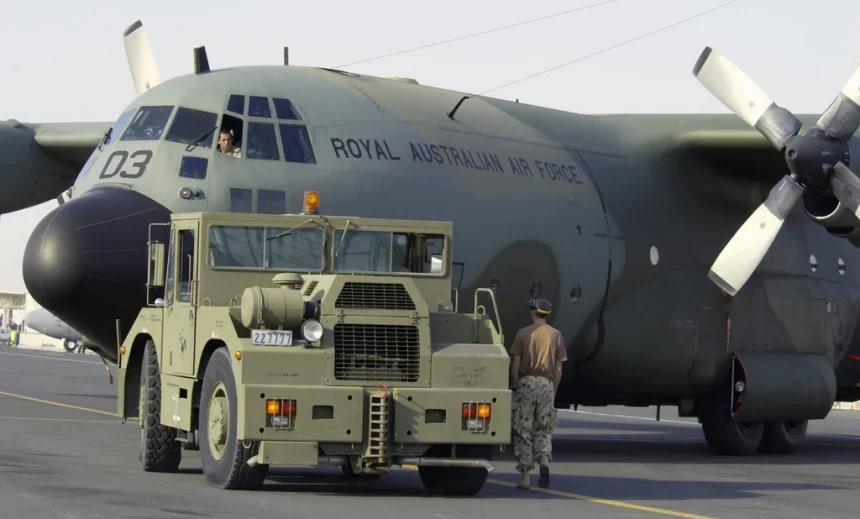
Australia has dispatched two military aircraft to the Middle East to help citizens stranded amid escalating regional conflict and disrupted commercial travel. The deployment marks a significant step in the government’s efforts to support Australians attempting to leave the region as tensions intensify and airspace restrictions complicate evacuation efforts.
The aircraft—operated by the Australian Defence Force (ADF)—are part of a broader government response that includes crisis response teams and coordination with commercial airlines to facilitate repatriation flights.
ADF Aircraft Sent to Support Evacuation Efforts
Two Royal Australian Air Force aircraft have been deployed to the Middle East to assist Australians attempting to return home as the regional security situation deteriorates. As The Guardian reports, the aircraft were sent to support citizens stranded across the region while the government works to arrange additional repatriation flights.
The deployment is part of a contingency plan designed to assist Australians in countries affected by the widening Middle East crisis. Officials say the aircraft can be used to transport citizens from high-risk areas to safer transit hubs where commercial flights remain available.
The mission forms part of a broader evacuation effort known as Operation Beech, which was launched as regional tensions escalated following military strikes and retaliatory attacks across the Middle East.
Rising Numbers of Australians Seeking to Leave the Region
Thousands of Australians are believed to be in the Middle East, with many seeking assistance to leave as the conflict spreads and aviation disruptions intensify. As News.com.au reports, more than 115,000 Australians are estimated to be in the region, and many have contacted authorities for guidance about returning home.
Closed airspace, missile attacks, and security concerns have forced airlines to cancel or reroute flights, leaving travellers with limited options for leaving the region. In response, the Australian government has prioritized helping citizens reach locations where commercial travel is still operating.
Officials say that military aircraft will supplement—not replace—commercial evacuation flights.
How the Military Aircraft Will Be Used
The ADF aircraft are expected to support evacuation logistics rather than conduct direct rescue operations inside conflict zones. As The Australian reports, the aircraft include heavy transport platforms such as the RAAF C-17 Globemaster, capable of carrying large numbers of passengers or humanitarian supplies.
These aircraft can move citizens from regional transit points—such as the United Arab Emirates—to other destinations where flights to Australia are available. The military’s logistical capabilities also allow for rapid redeployment if security conditions change.
Australia has used similar aircraft in previous evacuation operations, including disaster relief missions and international humanitarian responses.
Government Deploys Crisis Teams Alongside Aircraft
The aircraft deployment is only one element of a larger government response. Six crisis response teams from the Department of Foreign Affairs and Trade (DFAT) have also been dispatched to the region to help coordinate evacuation efforts and assist Australians on the ground.
As The Nightly reports, these teams are working with airlines, local authorities, and diplomatic missions to organize safe routes out of affected areas and support repatriation flights.
Officials say the teams will provide consular assistance, help travelers navigate border procedures, and coordinate transport to airports.
Political Pressure Over Evacuation Strategy
The government’s response has drawn political scrutiny in Australia, with opposition figures questioning whether evacuation measures are sufficient.
As SBS News reports, some lawmakers have called for greater transparency about how the military aircraft will be used and whether additional resources should be deployed.
Critics argue that the government should move faster to assist Australians stranded in conflict zones, while officials insist that safety considerations and rapidly changing conditions make evacuation planning complex.
Foreign Minister Penny Wong has said the government remains focused on ensuring Australians can leave safely while monitoring the evolving security situation.
Commercial Flights Remain the Primary Evacuation Route
Despite the military deployment, authorities emphasize that commercial aviation will remain the primary method of returning Australians home.
Several chartered or commercial flights have already transported hundreds of Australians from Middle Eastern transit hubs to Australia. However, flight availability remains uncertain as airlines continue to adjust routes due to security concerns.
The ADF aircraft are therefore intended to provide flexible support, allowing the government to move citizens quickly between locations if commercial travel becomes unavailable.
Growing Uncertainty as Regional Tensions Escalate
The deployment reflects growing international concern that the Middle East conflict could expand further, affecting travel routes and diplomatic operations across the region.
For Australians still overseas, the situation remains fluid. Authorities are urging citizens to register with consular services and follow official travel advisories while evacuation arrangements continue.
The use of military aircraft highlights the seriousness of the situation—and the logistical challenge of helping thousands of citizens return home from one of the world’s most volatile regions.
7 years in the field, from local radio to digital newsrooms. Loves chasing the stories that matter to everyday Aussies – whether it’s climate, cost of living or the next big thing in tech.