




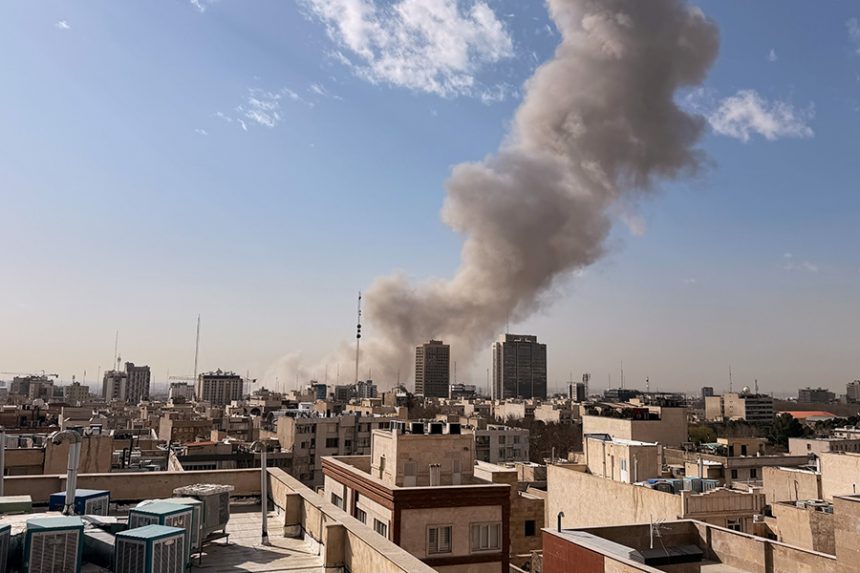
In one of the most dramatic escalations in recent Middle Eastern history, Iran has launched retaliatory attacks across the region following coordinated airstrikes by the United States and Israel targeting key Iranian leadership, military and strategic sites. The unfolding conflict, which erupted on 28 February 2026, represents a significant widening of hostilities that had already been simmering for months over disputes involving Iran’s nuclear program, regional proxy networks and deep-seated geopolitical rivalries.
Iran’s response has involved a combination of ballistic missile and drone strikes directed at Israeli territory and American military assets stationed in Gulf states and other allied positions — a forceful demonstration of Tehran’s capacity and willingness to retaliate. Governments and international organisations have responded with alarm, warning that the conflict risks drawing in a wider array of actors and inflicting heavier civilian casualties if unchecked.
The Precipitating Strikes: Operation “Lion’s Roar”
The immediate trigger for Iran’s expansive counter-offensive was a major coordinated military operation carried out by the United States and Israel against Iranian territory, dubbed Operation Lion’s Roar by Israeli officials. The strikes reportedly hit multiple locations across Iran, including Tehran, Isfahan, Tabriz, Kermanshah and Qom, targeting military infrastructure, intelligence facilities and areas associated with political and defence leadership.
Explosions were widely reported over Tehran and other cities, prompting airspace closures and emergency responses. Satellite imagery showed significant smoke plumes and damage around highly sensitive areas, although the exact status of top Iranian leaders remained unclear in the initial hours.
The strikes came amid heightened tensions over Iran’s nuclear ambitions and proxy engagements across the region. The U.S. government framed the offensive as a pre-eminent defence against a perceived imminent threat, while Israeli leaders emphasised the necessity of disabling Tehran’s strategic capabilities.
Tehran’s Retaliation: A Broad Regional Response
Iran’s response was swift and comprehensive. Within hours of the initial assault, Tehran’s armed forces — principally the Islamic Revolutionary Guard Corps (IRGC) — launched missile and drone attacks targeting:
- Israeli territory and military installations, where air-raid sirens were sounded across multiple cities;
- U.S. airbases and naval facilities in Gulf states, including Qatar, Kuwait, the United Arab Emirates, Bahrain and Saudi Arabia;
- Additional strikes were reported against coalition bases in Iraq and Jordan.
Iranian commanders publicly declared that “all American and Israeli assets and interests in the Middle East have become legitimate targets” in retaliation for what Tehran characterised as a breach of its sovereignty. Iranian officials described the counter-offensive as necessary to defend the homeland and warned of prolonged hostilities if the assaults continued.
The breadth of the response — spanning multiple nations and U.S. facilities — signals the potential for a protracted and geographically diffuse conflict, rather than a limited confrontation confined to Iran’s borders.
Civilian Impact and Humanitarian Concerns
The human toll of the initial U.S.–Israeli strikes was already significant before Iran’s counter-attacks. Reports emerging from Iranian state sources cited dozens of civilian deaths, including at least young schoolchildren in Minab, southern Iran, when a strike reportedly hit a girls’ elementary school. This incident has been widely circulated in Iranian media and further inflamed public sentiment, though independent verification remained limited in the earliest stages of reporting.
Airspace closures across Iran, Iraq and the UAE have prompted widespread travel disruptions, with airlines canceling or diverting flights amid security warnings and missile alerts. Such disruptions have compounded the immediate humanitarian and economic stresses brought on by the fighting.
As hostilities continue, international aid groups and diplomatic missions have raised alarms about the rising civilian risk, urging combatants to protect non-combatants and adhere to international law.
Regional and Global Diplomatic Reactions
The escalation has drawn strong reactions from global powers and regional actors alike. The United Nations Secretary-General and the European Union have both called for maximum restraint and immediate cessation of hostilities, warning that further military escalation could destabilise the entire Middle East with cascading humanitarian, economic and security consequences.
Meanwhile, Russia has condemned the U.S.–Israel strikes as an act of armed aggression and a violation of international norms, underscoring Tehran’s calls for an emergency session of the UN Security Council. Moscow reaffirmed its readiness to assist in diplomatic efforts, even as it reiterated support for Iran’s position.
Other regional governments — including several Gulf states hosting U.S. assets — have publicly criticised Iran’s violation of their sovereignty due to attacks emanating over their territory, adding another layer of diplomatic strain to already complex relationships.
Military Uncertainties and Strategic Implications
The evolving conflict raises critical military uncertainties. Reports suggest that some senior Iranian military commanders may have been killed in the initial airstrikes, although confirmation has varied across sources and remains a point of contention.
Iran’s ability to strike multiple U.S. bases — including in Qatar and Bahrain — highlights both the reach of its ballistic missile and drone capabilities and the potential vulnerability of coalition forces throughout the region. This escalation echoes previous confrontations, such as significant Iranian missile strikes in 2025, but the current scale may represent a new phase of intensity and geographic spread.
The presence of coalition air defences and international intercept operations has likely mitigated the devastation in some areas, but the risk of miscalculation remains high.
Outlook: A Conflict Without a Clear End
As the situation continues to evolve, diplomats, military analysts and civilian observers are warning of the danger of a wider conflagration. The combination of direct strikes on sovereign territory, the targeting of third-party bases and the involvement of multiple nations’ armed forces raises the spectre of a broader regional war with unpredictable consequences.
Calls for negotiation and de-escalation persist, but the ferocity of the attacks and counter-attacks — coupled with deep mutual mistrust between Tehran, Washington and Jerusalem — suggest that any diplomatic breakthrough will be challenging in the immediate term.
For the inhabitants of the Middle East and beyond, the coming days will likely determine whether this crisis can be confined or whether it will herald a far more destructive phase of conflict.
7 years in the field, from local radio to digital newsrooms. Loves chasing the stories that matter to everyday Aussies – whether it’s climate, cost of living or the next big thing in tech.